As long as there is something to rest your eye on, as long as you can follow a curve or gaze at the shape of a line, as long as there are pools of color and a container for them, the image doesn't matter much
Gazing at a piece; I need to know if the texture is right, is the surface interesting, where do the colors start and where do they stop, what does the edge look like; is it real or does it look painted on, or both, what is on top of what, is there line? Where do they stop and start, does the start make sense? If it doesn't should I leave it, or not? Of course not making sense is mostly better.
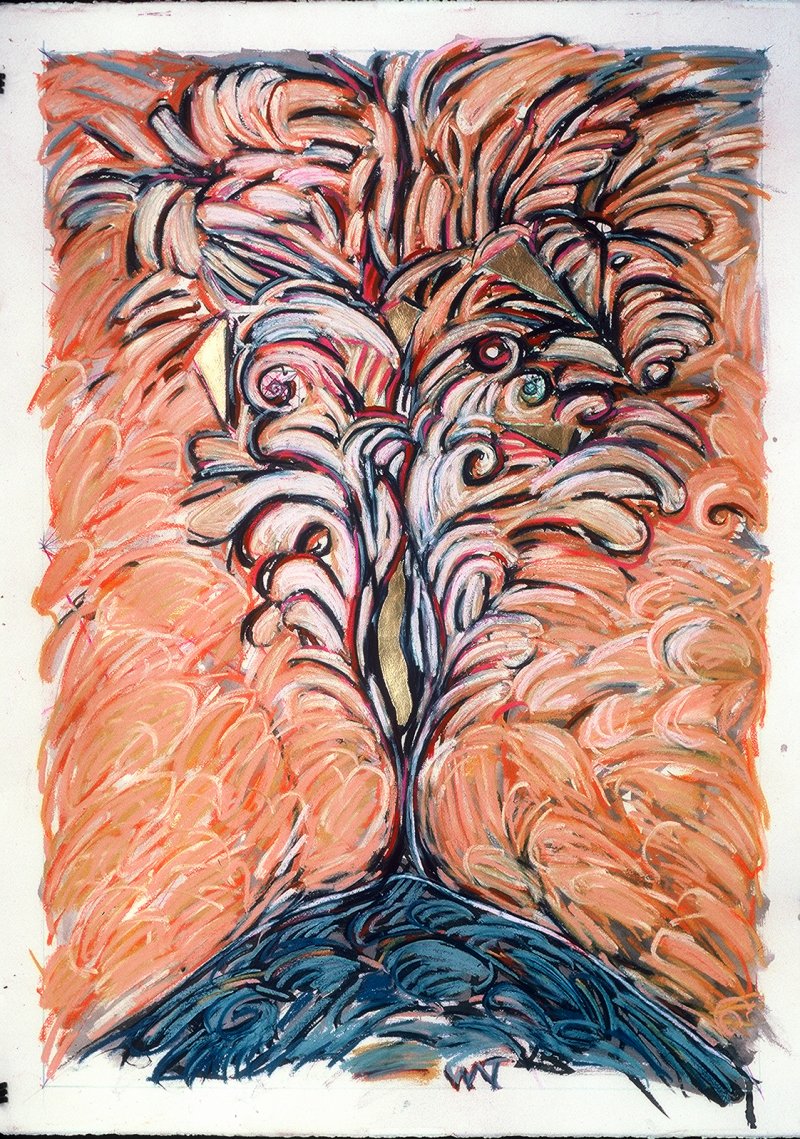
Does it enclose a shape? Is it positive or negative, figure or ground, (maybe it's neither figure nor ground or maybe both at once)? Is there a different shape on both sides of the line? Does it make a stick, a stone, the end of the road, the rest of the stump, or a little alone, (thanks Jobim) a leaf, a spike, a hamburger, a boot, a tire, a tree, a fish, a dog, some hair, a shirt, a slipper, a chair, a face or the waters of March...
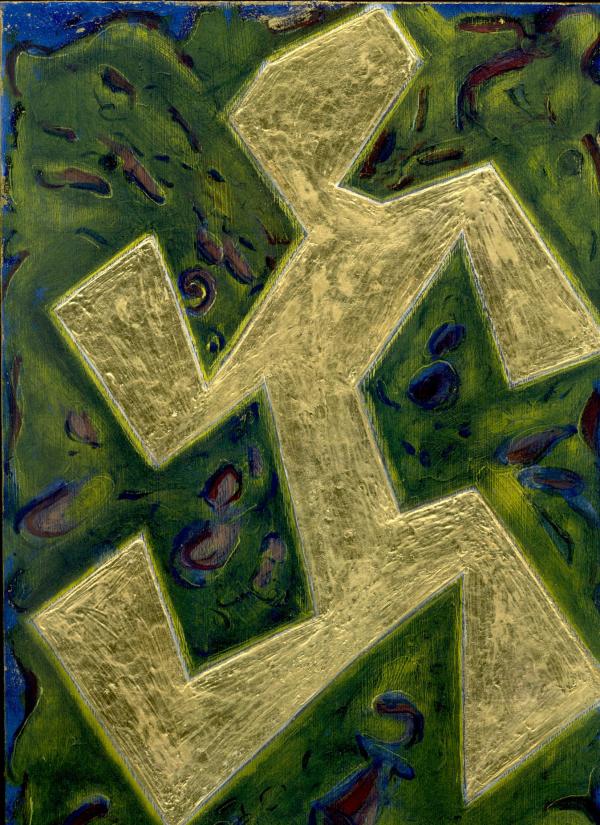
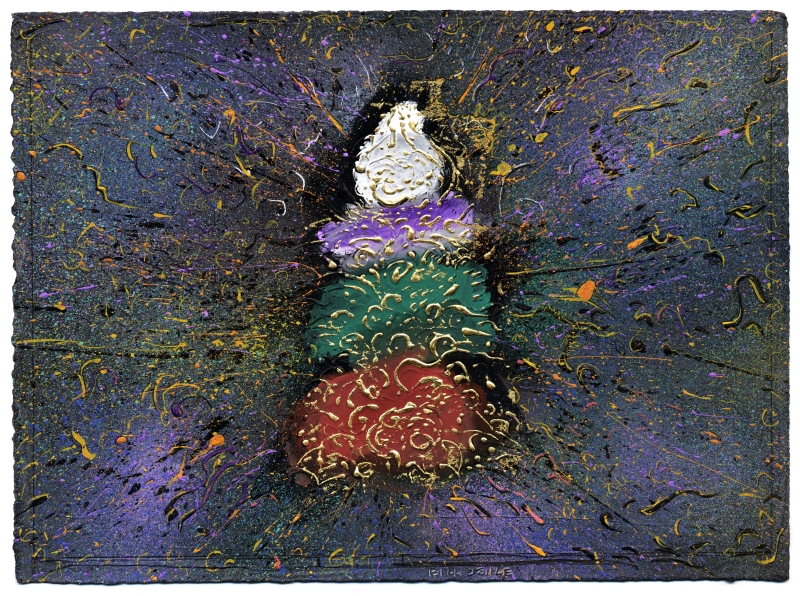
There are a couple of images I need to use. They are stand-ins for the real things that would be either impossible or unutterably corny to even begin to abstract. (All art is abstract.) So right now "Jumping-Boy," "Candle" and "Fountain" (unnamable but labeled) are just symbols or pointers to feelings or hallucinations I've had that are too personal to say out loud except in the most intimate setting.
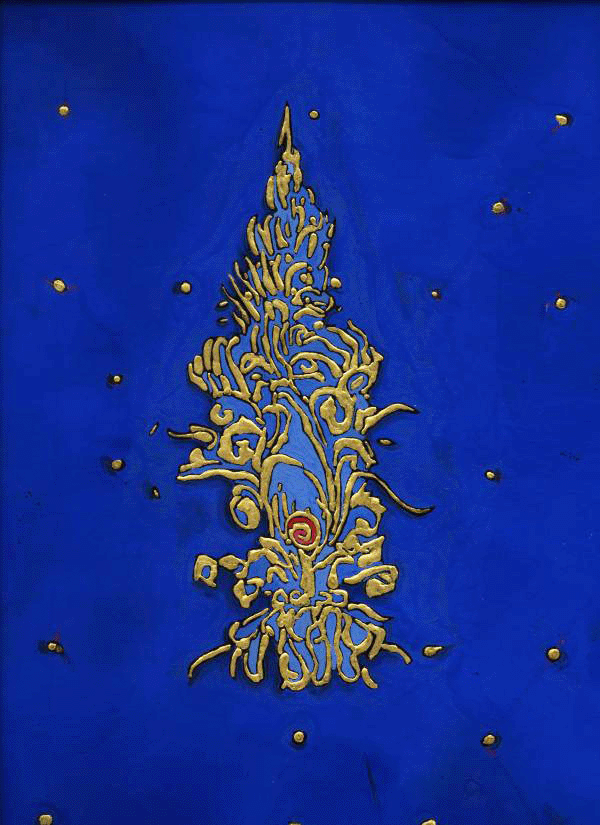
The "Candle" image started as a flame in the distance that might be the origin of the universe (in the "Courbetian" sense,) a chakra meditation chart and a floating golden and sacred object. Now it's come to mean for me also a boat on the surface seen from underwater, a heraldic emblem, maybe an amoeba-like animal, or a person taking a walk. Of course those all drag along their own baggage and weigh the meaning of the picture in ways that are difficult to control.
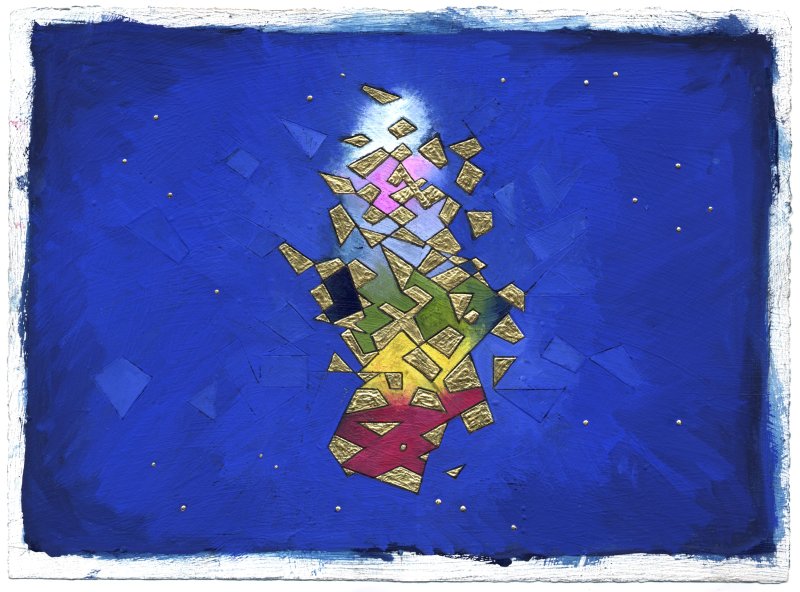
The new "Candle and Fountain" paintings contain a central sacred image floating free on a field of pure color. Like "BLUE FOUNTAIN 6" they are constructed with the same geometry as the "Jumping Boy" and all the other paintings up to this time, but for the most part the "geometry" is buried. To me, the geometry is the place it all has to start from. Much like the listener doesn't normally see the sheet music, the construction of the geometry under what is essentially an expressionist work gives the foundation and the skeleton to hang the Candle and Fountain series paint on. Some of that skeleton is visible in "Blue Fountain 17."
In the latest "Fountain Paintings," that central floating jewel is becoming more a part of the surrounding cosmos and embedded more into the floating shapes that surround it. With so much paint flying around (I call it Splattoscurro) there is a risk that the beauty of the paint itself will dominate, like in "BLACK FOUNTAIN 4." I never thought that paint splatters were interesting in themselves, so I decided to let the little shapes and the micro images that surface after much work come out to play. This allows the area surrounding the central image to invoke landscape, the sky from the ground, a Hubble shot, the oaks around my studio against the sky, cars winding up the canyon, the light on the water, etc. The central image has become less heraldic and more playful, but still retains the suggestion of a pool, a flap, a leaf, a spike, a burger, a boot, a tire, a tree, a fish, a dog, some hair, a shirt, a slipper, a chair, a face, the promise of life, etc...